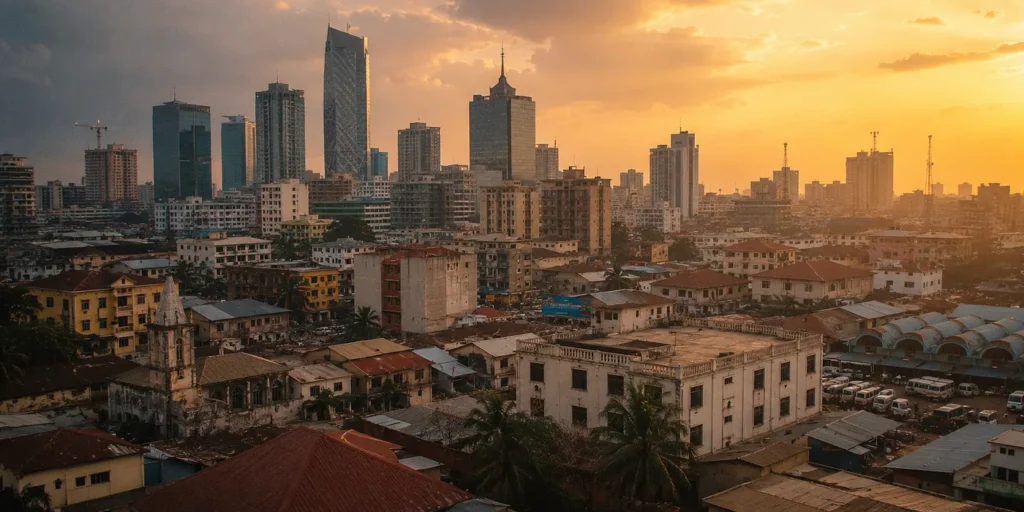
Walk through any major African city and pay attention to what you see.
- Glass towers that belong in Dubai.
- Churches that look like they were lifted from the American South and dropped onto West African soil.
- Office buildings with no memory of the climate they sit in, no acknowledgment of the sun that beats down on them, no relationship with the land they stand on.
- Malls with names that gesture toward European luxury.
- Hotels designed to make a foreign visitor feel at home while making a local feel like a guest in their own city.
Now ask yourself: whose idea of progress is this?
London has an identity. You feel it before you understand it. In the red brick, the Georgian terraces, the way old and new sit together without apology. The city knows what it is. It has argued with itself across centuries and arrived at something that could only be London.
New York has an identity. Relentless, vertical, unapologetic. You know where you are the moment you arrive. The city does not explain itself. It simply is.
Beijing has an identity. Ancient and modern in deliberate conversation. The Forbidden City and the CCTV headquarters occupy the same skyline, the same story, the same country’s idea of itself across time.
Accra could have an identity. Nairobi could. Lagos could. Abidjan, Kigali, Addis Ababa. Every one of these cities sits on soil with thousands of years of architecture, craft, philosophy, and aesthetics embedded in it.
But somewhere between then and now, we stopped building from that place.
We started building from someone else’s idea of what a serious city looks like. 🙁
The architecture is just the most visible symptom, which is the easiest thing to point at. The deeper problem runs through everything.
Take religion.
I want to be careful here because faith is personal, and this is not an argument against belief. But it is an argument about origin and ownership and what happens when a people adopt a spiritual framework that was, in many cases, delivered to them by the same hands that took everything else.
Christianity as practised across much of Africa did not arrive as an invitation. It arrived with colonisation. It was used, deliberately and strategically, to replace existing spiritual systems, to delegitimise African cosmology, to make people strangers to their own ancestors. And it worked. The borrowed became more sacred than the original. And the original became something to be ashamed of.
The same is true in parts of North and East Africa, where Islam is prevalent, though the history is different and the dynamics more complex.
The point is not that the faith is wrong. The point is what it signals about identity when a continent’s dominant spiritual frameworks both arrived from outside, both required the suppression of what existed before, and both are now so deeply embedded that questioning them feels like heresy rather than history.
Now bring this into the boardroom.
Because this is where it becomes a management problem, a leadership problem, a productivity problem that shows up in quarterly results and brand strategies, and the way African companies price themselves in global markets.
The African executive who was educated in a Western system, worships in an imported tradition, works in a building designed without reference to local context, and leads a company modelled entirely on a Western corporate template, is making decisions from a borrowed identity. And borrowed identities have a particular weakness. They are always slightly uncertain of themselves. Always looking outward for validation, and always measuring success by someone else’s standard.
You see it in how African companies present themselves. The mission statements that sound like they were written in Delaware. The marketing that mimics global campaigns without asking whether the insight underneath them is relevant to the people being spoken to. The pricing that undersells, because somewhere deep in the organisation, there is an unexamined belief that what comes from here is worth less than what comes from there.
This is not a confidence problem in the way motivational speakers describe it. It is an identity problem. You cannot project clarity outward when there is confusion at the centre.
The companies that are breaking through globally from this continent (Africa) are the ones that stopped trying to look like something else.
The identity that Africa buried is not a liability in the global market. It is the advantage that African businesses have not yet learned to use.
The question for every leader reading this is uncomfortable but necessary.
When you make decisions, whose framework are you using? When you build your culture, whose template are you following? When you define what success looks like for your organisation, whose definition are you reaching for?
If the honest answer is that you are not entirely sure, that is worth sitting with. Because an organisation takes the shape of the identity at its centre. A leader who has not done the work of knowing who they actually are, beneath the education and the titles and the frameworks borrowed from other contexts, will build something that does not quite know what it is either.
And organisations that do not know what they are cannot communicate clearly, cannot price themselves correctly, cannot attract the right people, cannot retain them, cannot build cultures worth belonging to.
Identity is not a soft topic. It is the foundation on which everything else is built.
We have been building on someone else’s foundation for long enough. The cracks show up everywhere, in our cities, in our boardrooms, in the quiet uncertainty of talented people who have achieved everything they were told to want and still feel like something is missing.
What is missing has a name. We built everything. Just not in our own image.
The most productive thing an African leader can do right now is not learn another framework. It is unlearn the belief that the framework has to come from somewhere else.