My last night in Seattle, I was on a bus, tapping my card, waiting to be charged again.
It did not charge me.
A small screen told me I had already paid for this window of travel. That my $3 covered wherever I needed to go within a certain time. No new charge. No penalty for getting back on. Just a system that remembered I had already done the right thing and decided that was enough.
I sat back and watched the city move past the window.
I had spent the day the way you spend a last day somewhere. Trying to hold as much of it as possible before you have to let it go.
I found an African food joint through Google. Followed the pin through unfamiliar streets until the smell told me I was close before the map did. I sat down and ate something that tasted like home and felt, for a moment, like the distance between Seattle and Accra was smaller than it had been all week. You can be impressed by a place and still need something familiar at the end of it. That is not a contradiction. That is just being human.
Then the donation shop. Then the South Center Mall. Then back onto the bus, card in hand, ready to pay again.
And the bus said no. You are already paid for.
I thought about that for a long time on the ride back.
Because what the transit system in Seattle has built is not just an efficient payment process. It is a relationship with its citizens that starts from a completely different assumption than most systems I have encountered.
Most systems assume you will not pay if they do not make you. The barriers, the gates, the turnstiles, the security, all of it is built on the premise that the default human behaviour is avoidance. That, without enforcement, compliance disappears.
Seattle’s system is built on the opposite belief. That most people, given the chance, will do the right thing. That the cost of treating everyone like a potential fare evader is higher than the cost of the few who actually evade.
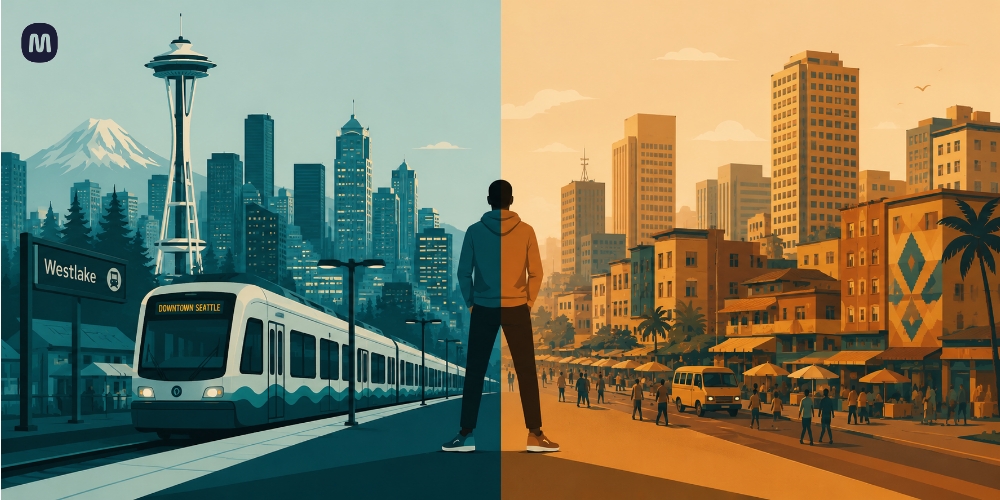
I walked past the train station and noticed you could board without paying if you wanted to. Nobody stopping you. No barrier between you and the platform. Just the implicit understanding that if you are here, you probably paid. And if you did not, that says something about you, not about the system.
In fact, I asked a lady why this is. She smiled and said, “This city is built on honesty!”
That sentence stayed with me because it is not just a statement about a transit system. It is a statement about culture. About what a community decides to believe about the people inside it.
Every system is built on a belief. The question is whether anyone ever made that belief explicit, or whether it just accumulated quietly over time until it became the air everyone breathes without thinking about it.
The belief underneath Seattle’s transit system is that people are fundamentally trustworthy. The belief underneath its donation shops is that surplus should move toward need. The belief underneath its bus billing, that one tap covers your journey for a window of time, is that your time matters, and so nickel and diming you is not the relationship we want with you.
These are not accidents. They are decisions. Made by leaders, by planners, by communities that sat down at some point and decided what they believed about the people they were building for.
I think about this when I think about the organisations I have been part of. The teams I have led. The systems we built, sometimes deliberately, more often by accident.
Every organisation is built on a belief about people. Some are built on trust. Others are built on control. And you can feel the difference the moment you walk in. Not in the mission statement. Not in the values poster on the wall. It’s in the small things. Whether information flows freely or gets hoarded. Whether people feel watched or felt. Whether the process exists to help people do good work or to make sure nobody can do anything wrong without being caught.
The best leaders I have encountered build like Seattle builds. From trust outward. They design systems that assume good intent and create the conditions for it to flourish. They treat the people inside their organisations the way that bus treated me. You have already shown up. You have already tapped in. We trust you from here.
My last night in Seattle. African food that tasted like home. A donation shop full of things people decided to give rather than keep. A bus that remembered I had already paid.
A city built on honesty.
I am taking that home with me. Not as a souvenir. As a standard.
Because if a transit system can decide to trust millions of strangers every single day, the least I can do is build the same assumption into every team, every process, and every system I am responsible for.
Trust is not naive. It is a design decision.
And it is one of the most powerful ones a leader can make.