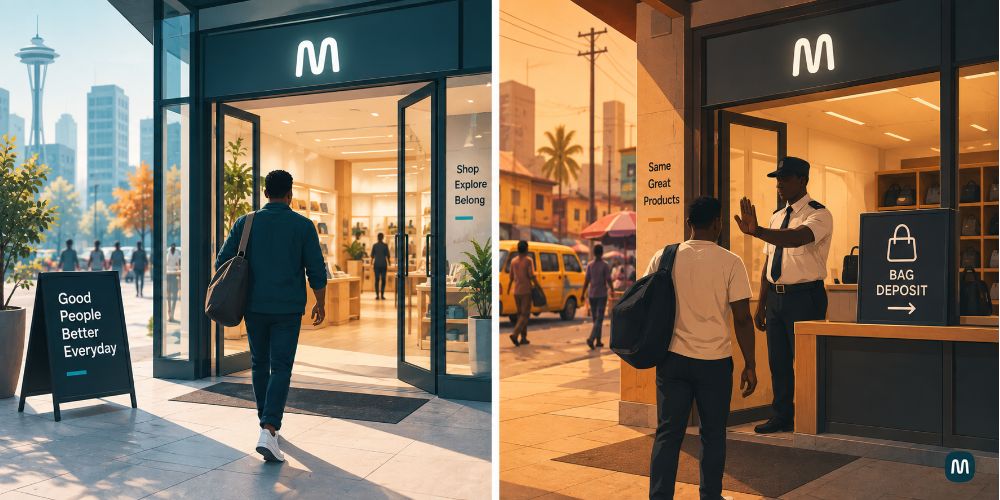
There is a shop in Accra you have almost certainly been to.
It could be a supermarket. A pharmacy. A clothing store. An electronics retailer. The brand might be local. It might be international. But the moment you walk in, someone stops you. Not to greet you. Not to ask if you need help. To take your bag.
Leave it at the counter. You can collect it on your way out.
The same brand, in many cases, has a location in London. In New York. In Paris. Nobody stops you at the door there. Nobody asks for your bag. You walk in, you browse, you pay, you leave. The transaction is built on a simple assumption. You are here to shop. Not to steal.
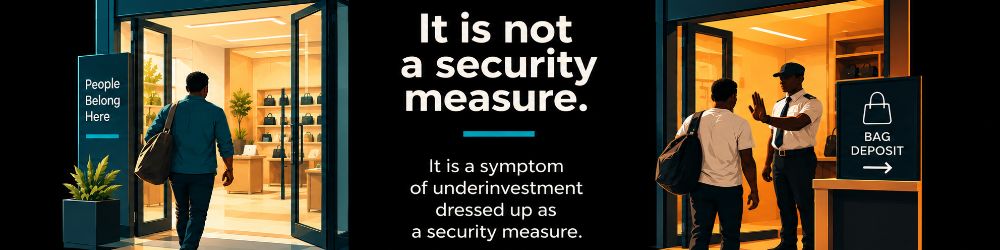
Same company. Same products. Different continent. Different assumption.
That asymmetry is worth examining honestly.
The easy answer is theft. Africa has higher shoplifting rates so retailers respond with stricter policies. But that answer does not survive scrutiny for very long.
Retail theft in the United States costs the industry an estimated 100 billion dollars a year. It is not a small or theoretical problem. Organised retail crime has been rising steadily. Major cities have seen high profile incidents of coordinated theft that made international news. American retailers are not operating in a low risk environment. They are operating in a high risk one with better tools for managing it.
That is the first difference. Not the risk. The response to it.
A Western retailer invests in infrastructure. CCTV systems that are monitored in real time, not recorded and forgotten. Electronic tags on merchandise that trigger alarms at the exit. Inventory management systems that flag discrepancies before they become patterns. Loss prevention staff trained in observation rather than confrontation. The system watches so that the human at the door does not have to.
The bag policy is what happens when you do not have that infrastructure. It is a low cost, low technology solution to a problem that better systems would handle invisibly. It works in a narrow sense. It also announces to every customer who walks through the door that they are not trusted until proven otherwise.
I wrote recently about a transit system in Seattle that operates on a fundamentally different assumption. You tap your card once and the system trusts you for a window of time. You can board a train without passing through a barrier. The city, as a woman on the platform told me, is built on honesty.
That honesty is not naive. It is backed by consequence. Fare evasion is a fineable offence with real enforcement. The trust is extended because the system behind it has weight. Remove the infrastructure and the trust becomes untenable. Which is precisely the situation many African retailers find themselves in.
The problem is not that African customers are less trustworthy. The problem is that African retail has not yet built the systems that make trust at scale possible. And in the absence of those systems, the bag policy feels like a reasonable substitute.
It is not. It is a symptom of underinvestment dressed up as a security measure.
But infrastructure only explains part of it. Because the infrastructure argument would predict that as African retailers invest in better systems, the bag policy disappears. And that is not always what happens.
Some retailers in Africa have the cameras. They have the tags. They have the inventory systems. And they still ask for your bag at the door.
Which brings us to the second explanation. And the more uncomfortable one.
The bag policy, in those cases, is not a systems decision. It is a belief decision. It reflects what the organisation believes about the people walking through its doors. And that belief, in many international brands operating on this continent, was formed somewhere else, carried across, and applied without examination.
The customer in London is assumed to be a shopper. The customer in Accra is assumed to be a risk. Same brand. Same products. Different belief about the human being on the other side of the transaction.
That is not a policy problem. That is a values problem. And it will not be solved by better cameras.
There is a third layer that rarely gets discussed. The self fulfilling nature of the assumption itself.
When you treat people like potential thieves, you do not just offend them. You define the relationship before it has begun. You establish, from the first moment of contact, that this is a transaction built on suspicion rather than service. And organisations built on suspicion tend to get the behaviour they expected. Not because the customers were always going to steal. But because trust, extended genuinely, tends to produce trustworthy behaviour. And suspicion, extended consistently, tends to produce the opposite.
The retailers who treat their African customers with the same dignity they extend to their Western ones are not being naive about risk. They are being intelligent about relationship. They understand that the cost of occasional theft is lower than the cost of an entire customer base that feels unwelcome every time they walk through the door.
The solution is not simply to remove the bag policy and hope for the best. It is to build the systems that make the policy unnecessary. To invest in the infrastructure that allows trust to be extended without being naive. To train staff in service rather than suspicion. And to examine, honestly, what your organisation believes about the people it serves. Because the policy at the door is never just a policy. It is a statement of belief. And customers, regardless of continent, can always tell the difference between a business that sees them as a valued guest and one that sees them as a managed risk.
Africa deserves retail built on the same assumption that Seattle built its transit system on. That the person walking in is probably here to do the right thing. That trust, extended first, is not weakness. It is the foundation of every relationship worth having.
The bag policy says we do not believe that yet.
Building the systems and the culture to believe it is the work.