I bought a new office workstation recently.
Paid for it. Waited while they packaged it. Watched them load it onto a trolley. Followed them to the car park as they wheeled it down. Opened my boot. Watched them lift it in.
And from the moment they picked it up to the moment they set it down, they asked for a tip. Not once. Repeatedly. With the quiet insistence of people collecting what was already owed to them.
When I questioned it, they got angry.
Not disappointed. Not persuasive. Angry. As though I had done something wrong. As though the tip was already theirs and I was the one creating a problem by not handing it over.
I drove away thinking about that anger for a long time.
Tipping exists everywhere. That is worth saying clearly before this becomes a simple criticism of Ghanaian service culture. In the United States, tipping is deeply embedded in how service industries work. In Las Vegas, where service is almost theatrical in its attentiveness, tipping is practically a language. The bellman who carries your bags, the dealer who runs your table, the waitress who remembers your order without writing it down. They all expect a tip. And in most cases they earn it.

But here is what Las Vegas has that Ghana does not.
A system.
In Las Vegas you know before you arrive that tipping is part of the transaction. The base wages in service industries are structured around the assumption that tips will supplement them. The quality of service is calibrated to earn the tip. You decide the amount. You decide whether the service warranted it. The power sits with the customer, not the person serving them. And the person serving you understands that the tip is earned, not given. That your decision about how much to leave is a direct reflection of how well they did their job.
That dynamic creates something remarkable. It creates an incentive for excellence. The server who goes above and beyond earns more. The one who does the minimum earns less. The system rewards performance in real time, directly, without waiting for an annual review or a manager’s assessment.
Ghana has the ask. It does not have any of that.
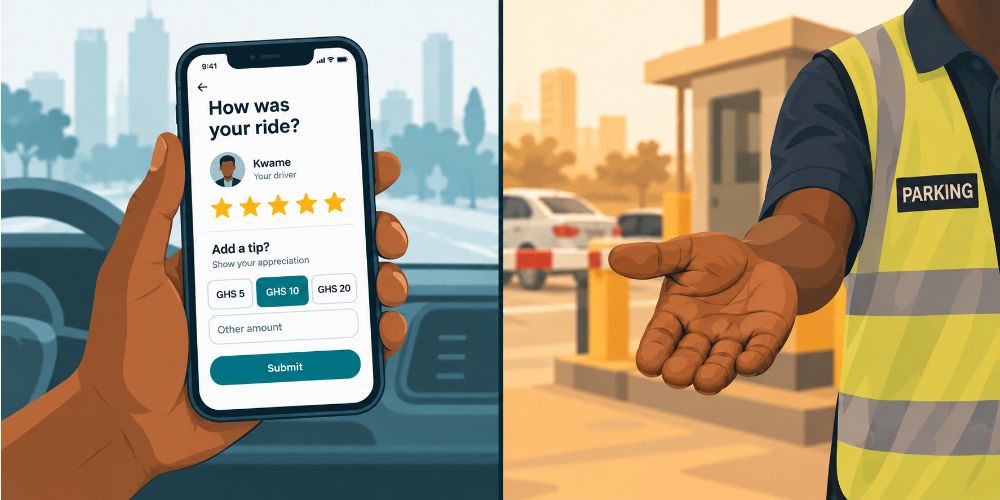
What happened in that car park was not tipping. Tipping is a reward for service that exceeded the expectation. What those delivery men were doing was something different. They were treating a standard part of their job, delivering the item the customer had already paid for, as an extraordinary favour that warranted additional payment.
The job was to deliver the workstation. They delivered the workstation. That is not above and beyond. That is the job.
The entitlement behind the ask, and especially behind the anger when the ask was questioned, reveals something about how service is understood in that context. Not as a standard to be met and exceeded, but as a transaction to be squeezed. Every interaction becomes an opportunity to extract something additional from the customer. Not by performing better. Just by asking louder.
That is not a service culture. It is an extraction culture. And it has consequences that go far beyond a tense moment in a car park.
The technological parallel is worth making here because we are living through a moment when service is being radically redefined by systems.
Uber does not rely on tips to create good service. It relies on ratings. Every driver knows that the score they carry determines the rides they get. A consistently low score means fewer opportunities. A consistently high one means more. The incentive for excellence is baked into the infrastructure. The customer does not have to say anything. They just rate. And the system does the rest.
Airbnb works the same way. The host who goes above and beyond builds a reputation that compounds over time. Reviews are public. Standards are visible. Excellence is rewarded not by a tip at the end of the stay but by a pipeline of future guests who chose them because of what previous guests said.
These systems did not make tipping irrelevant. They made performance the currency. And they put the accountability where it belongs. With the person providing the service, not with the customer being pressured to subsidise it.
Ghana’s service sector is largely operating without that infrastructure. Without ratings, without public accountability, without any mechanism that connects the quality of service to the reward it generates. And in that vacuum, the ask fills the space. Not because the people asking are bad, but because nobody built the system that would give them a better way to earn more.
This is not just a tipping problem. It is a systems problem.
A country where service workers feel entitled to tips regardless of performance is a country that has not built the feedback loops that make performance matter. A country where customers are made to feel guilty for questioning an unreasonable ask is a country where the power in service transactions is inverted. The person being served ends up managing the feelings of the person serving them. That inversion costs everyone.
- It costs customers who learn to dread the ask and start avoiding certain interactions entirely.
- It costs businesses whose reputation suffers every time a customer leaves feeling extracted rather than served.
- And it costs the service workers themselves who could be earning significantly more through genuine excellence but have no system that would reward them for it.
The solution is not to shame the person asking. It is to build the infrastructure that makes the ask unnecessary. Rating systems. Performance incentives. A culture inside organisations that connects service quality to career progression. Technology that makes accountability visible and excellence rewarding.
Las Vegas did not get a great tipping culture by accident. It got it by building an entire ecosystem around the idea that exceptional service deserves exceptional reward. And that the customer, not the server, decides what exceptional means.
Ghana can build that. The technology exists. The frameworks exist. The only thing missing is the decision to build service culture on performance rather than pressure.
The men who delivered my workstation were doing their job. They could have done it with pride, with care, with the kind of attentiveness that makes a customer want to tip generously without being asked. Instead they asked before they started. They asked while they worked. They asked when they finished. And when I questioned it, they got angry.
Nobody taught them that excellence earns more than entitlement. Nobody built a system that would show them the difference.
That is the real problem. And it is fixable.