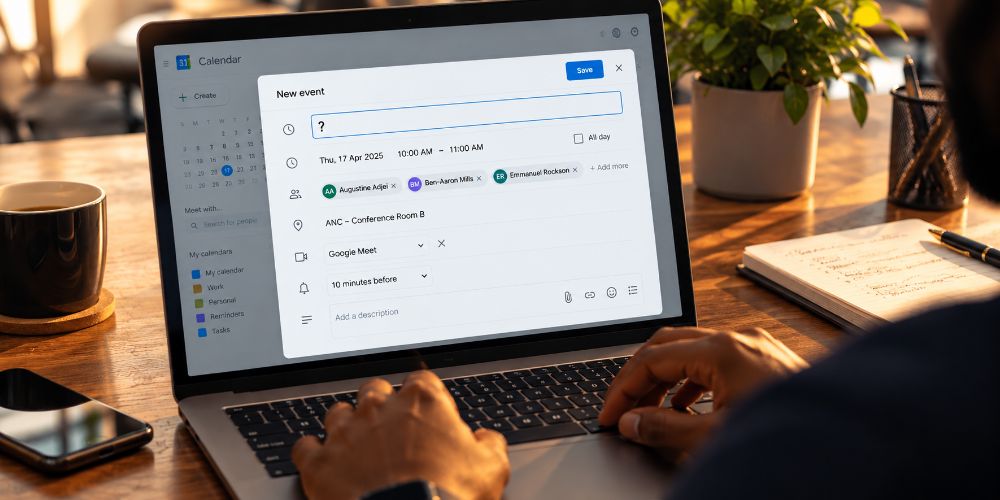
There is a meeting happening somewhere in your organisation right now.
Eight people are in a room or on a call. Some have their cameras off. Some are half reading an email from another thread. Someone is presenting slides that were emailed to everyone last night and that nobody read. Someone else is waiting for the part that is relevant to them so they can mentally check back in. The most senior person in the room has not said anything yet. Everyone is waiting to see which way they lean before committing to a position.
At the end of it someone will say great discussion and an action will be assigned to a person who was not entirely sure how they ended up responsible for it.
Nobody will ask what the meeting was actually for.
This is not a complaint about meetings. Meetings are not the problem. The problem is the decision that does not happen before the invite goes out. The moment where someone should stop and ask a simple question that almost nobody asks.
What does this moment need to do?
Not what do we need to discuss. Not who needs to be in the room. Not how long should we book. What does this moment need to actually accomplish. And is a meeting the right container for it.
That question sounds obvious. It is almost never asked.
There are things that meetings do extraordinarily well. Things that no document, no email, no Teams message can replicate.
Meetings build trust. The physical or virtual presence of people in the same space, navigating something together in real time, creates a kind of alignment that words on a page cannot manufacture. When a team has been in conflict, the meeting is where the conflict gets resolved. Not because someone writes the right words but because the right people are in the same room and the dynamic shifts in a way that only happens in real time.
A document tells you what someone was willing to commit to in writing. A meeting tells you what they actually think. The hesitation before the answer. The question that comes from an unexpected direction. The silence after a proposal that says more than any response would. These are signals that only exist in conversation and that disappear entirely when communication moves to asynchronous formats.
Meetings make decisions with shared ownership. When a room of people arrives at a conclusion together, they leave with something a document cannot give them. The memory of having been there. Of having contributed. Of having heard the reasoning and chosen to commit. That shared ownership changes how people execute. It is the difference between a decision that was handed down and a decision that was made together.
But here is what meetings cannot do.
They cannot transfer information efficiently. A meeting called to share an update that could have been written down is a meeting that treats eight people’s time as less valuable than the comfort of the person who did not want to write it up. Reading is faster than listening. A document can be skimmed, referenced, returned to. A spoken update in a meeting disappears the moment it is said and lives only in the imperfect memories of everyone who was half paying attention.
They cannot think for the organisation. The belief that putting smart people in a room produces smart outcomes is one of the most expensive myths in corporate life. Groups in meetings tend toward consensus, toward the position of the most senior person, toward the safest answer rather than the most interesting one. The thinking that produces genuinely new ideas almost always happens before the meeting or after it. Rarely inside it.
And they cannot replace the clarity that only comes from writing something down.
This is where the document earns its place. And where it is most consistently underused.
Writing forces precision in a way that speaking never does. When you have to put something in a sentence, you discover very quickly whether you actually understand it. The thing that seemed clear in your head becomes murky the moment you try to write it down. That murkiness is not a failure of writing. It is the writing doing its job. Revealing that the thinking was not yet finished.
Amazon famously banned PowerPoint in meetings. Instead, every meeting begins with a written narrative that participants read in silence for the first fifteen minutes. The logic is simple. A narrative forces the writer to think in complete sentences and complete arguments. It cannot hide behind a bullet point that gestures toward a thought without finishing it. And reading it together before discussion means everyone enters the conversation having actually processed the information rather than half listening while composing their response.
The document is not the bureaucratic alternative to the meeting. It is the thinking that should precede almost every meeting worth having.
The organisations that communicate well have figured out something that most have not.
Format is a decision. One of the most important decisions in any communication. And like most important decisions it needs to be made consciously, before the calendar invite goes out or the document gets started, not discovered accidentally when the meeting ends without a conclusion or the document circulates for three weeks without producing any action.

The question is not meetings versus documents. It is what does this moment need to do and what is the right container for it.
- If it needs to build trust, resolve tension, or make a decision with shared ownership, it probably needs a meeting. A real one with the right people and a clear purpose stated before anyone shows up.
- If it needs to transfer information, build an argument, or create a record that people can return to, it probably needs a document. Written with the precision that only comes from caring enough to finish the thought before sending it.
- If it needs both, it probably needs a document first and a meeting second. Write the thinking down. Let people process it. Then bring the right people together to do the thing that only a conversation can do.
The cost of getting this wrong is not just time. Although the time cost is real and significant. It is clarity. The organisation that consistently uses the wrong format for the wrong purpose becomes an organisation where nobody is quite sure what was decided, who is responsible, or why the thing they are working on matters.
That confusion does not show up on a balance sheet. But it shows up in the culture. In the low grade frustration of talented people who spend their days in rooms that go nowhere and reading documents that say nothing. In the slow erosion of trust in leadership that cannot communicate clearly. In the turnover of the people who eventually decide their time is worth more than this.
Before the next invite goes out, ask the question. Not who needs to be in the room. Not how long to book. Not whether to do it on Zoom or in person.
What is this moment actually for.
The answer to that question determines everything else. And it takes about thirty seconds to ask it.
Most organisations have never spent those thirty seconds. The cost of that is everywhere if you know where to look.